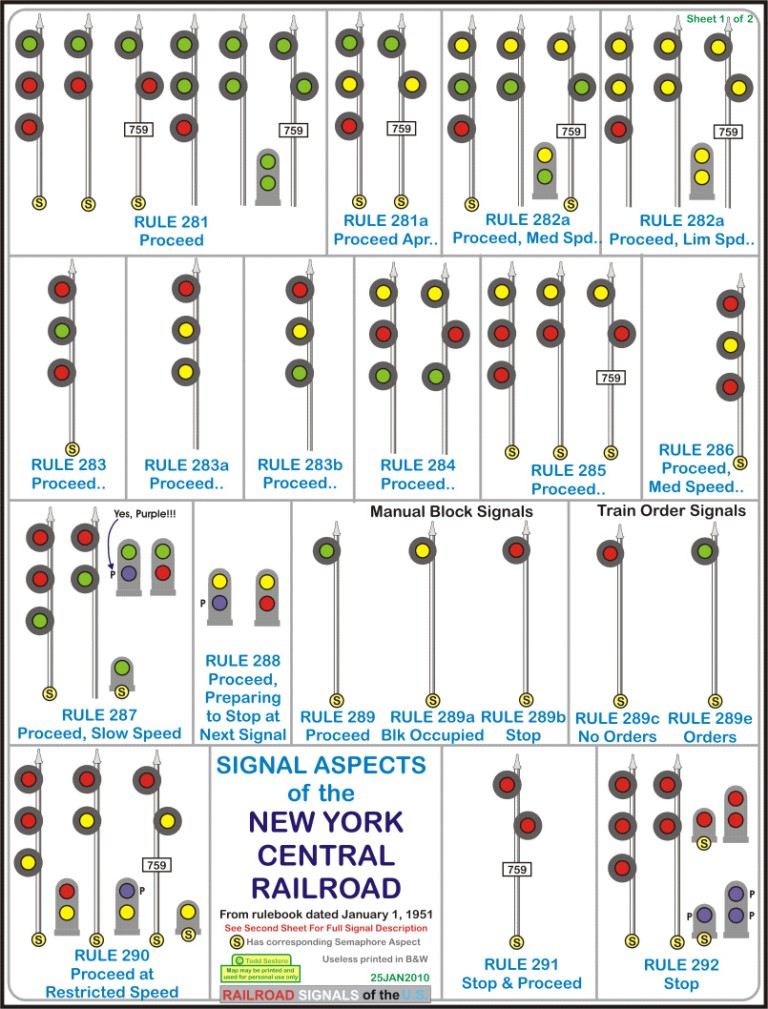
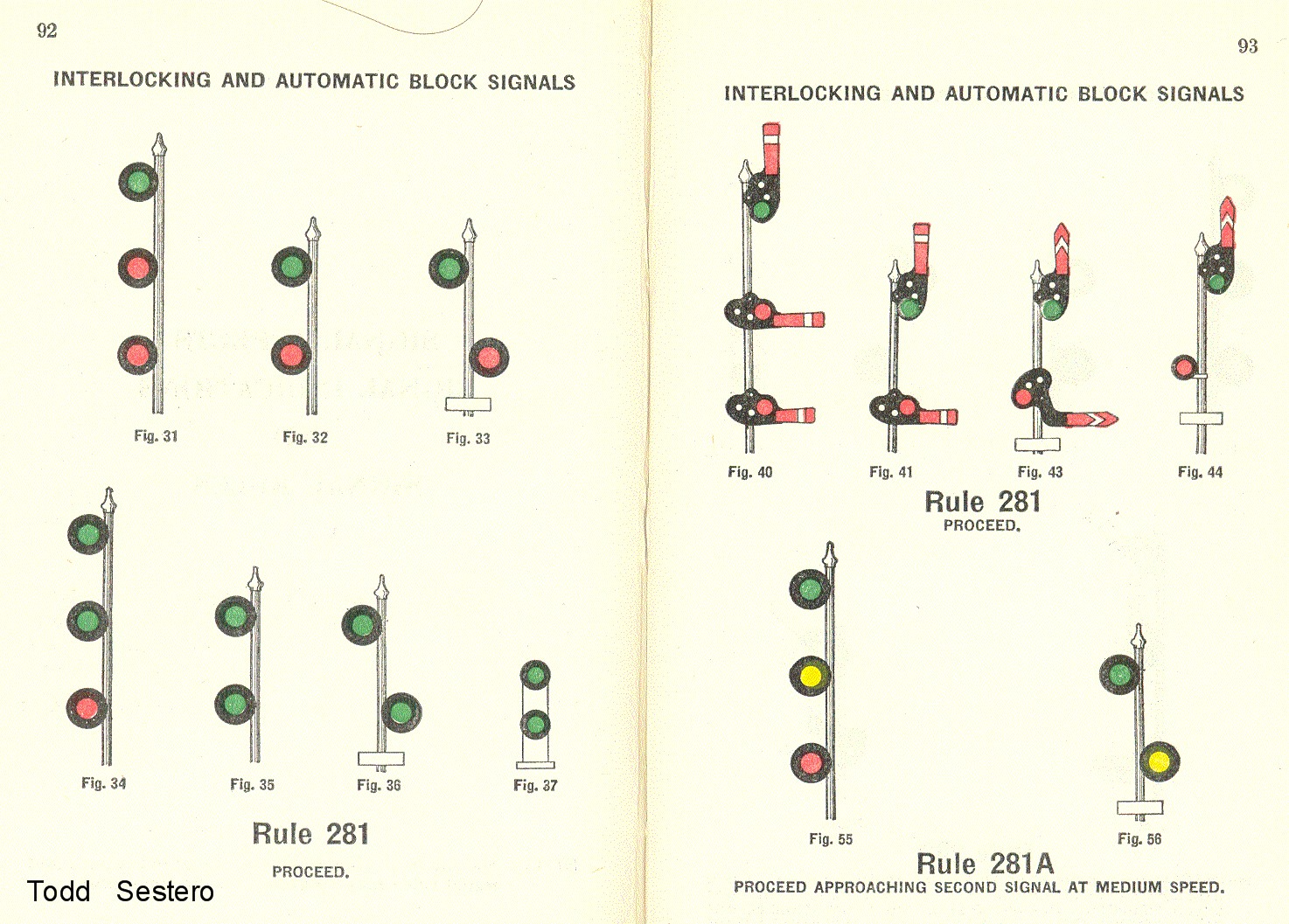
For instance, you won't see the green over green aspect today, EXCEPT for maybe some dwarf installations on former NYC trackage (that's according to the 1988 reference card for Conrail indications). This is
because today, the generally accepted practice is to assign the top head to high speed routes and the middle head to medium speed routes, and you can't assign a clear to both at the same time.
Note rule 281 is called PROCEED instead of CLEAR as is the practice today.
Another thing not noticed until you examine the actual rulebook pages is that the signal indications don't have a NAME, as is customary today, they just have a description.
In looking at the rulebook pages, you will also note the following things:
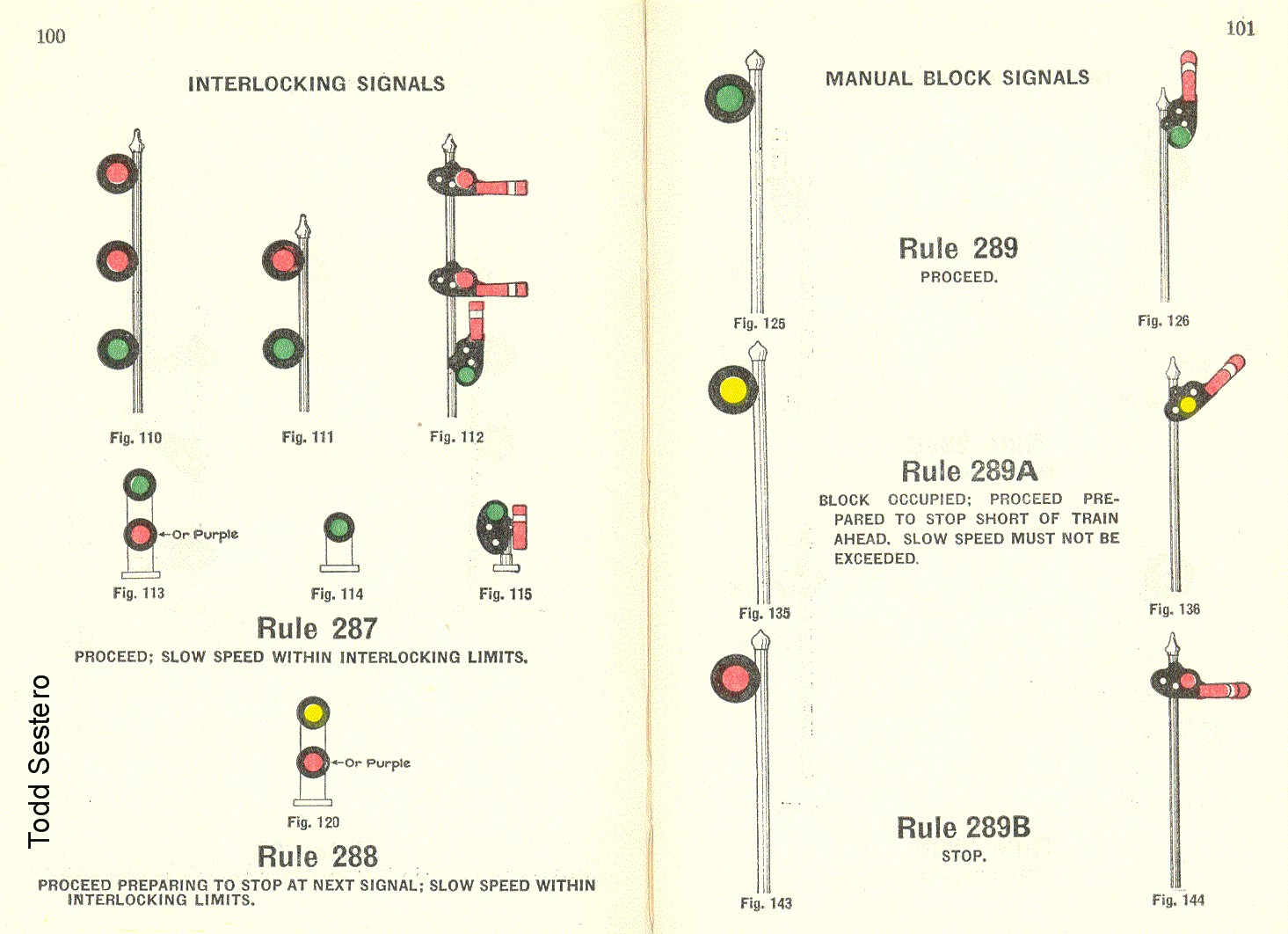
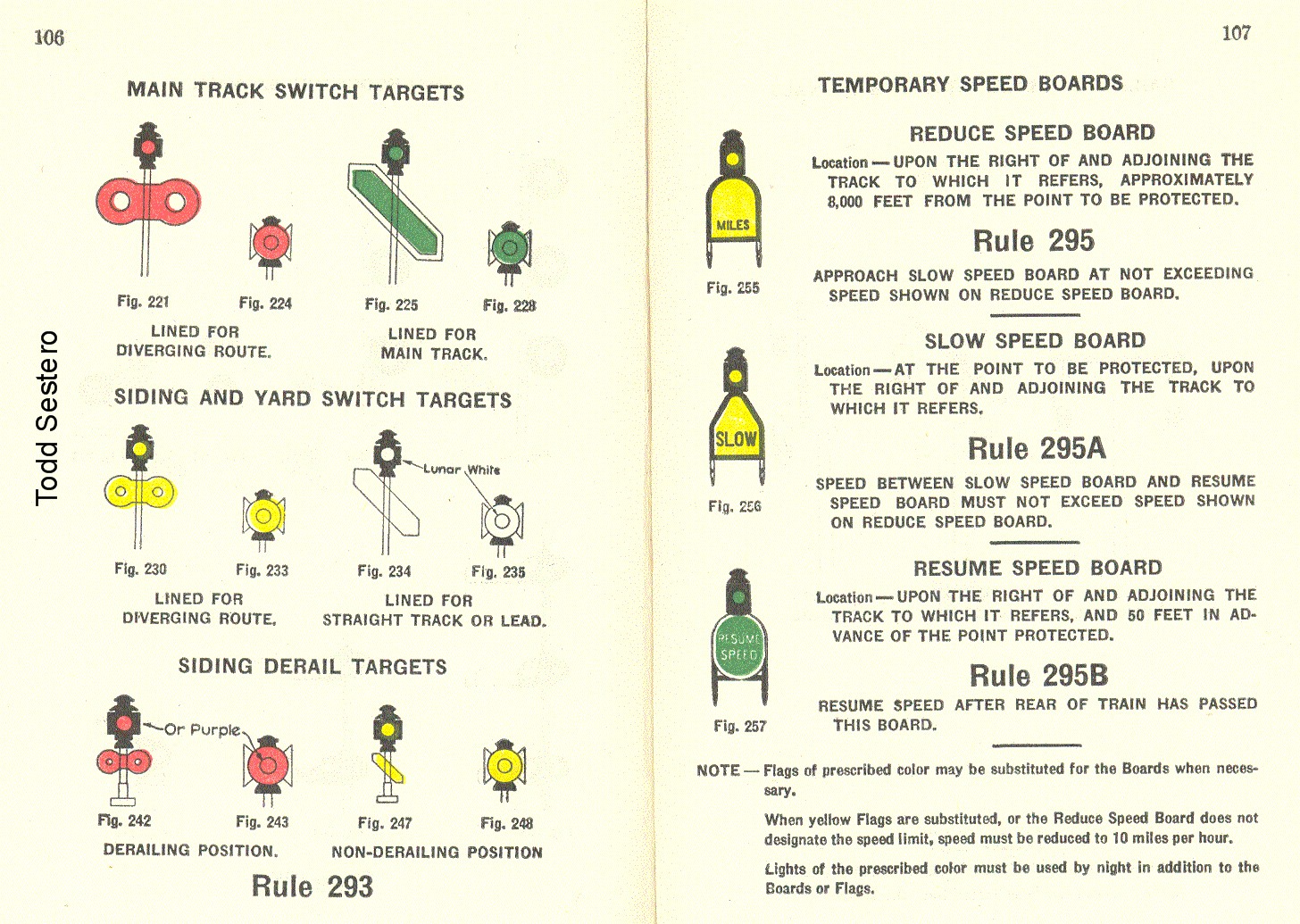
The use of PURPLE as an alternative to red in:
Rules 287 and 288 - In the bottom position of the
2 aspect dwarf color light dwarf signal.
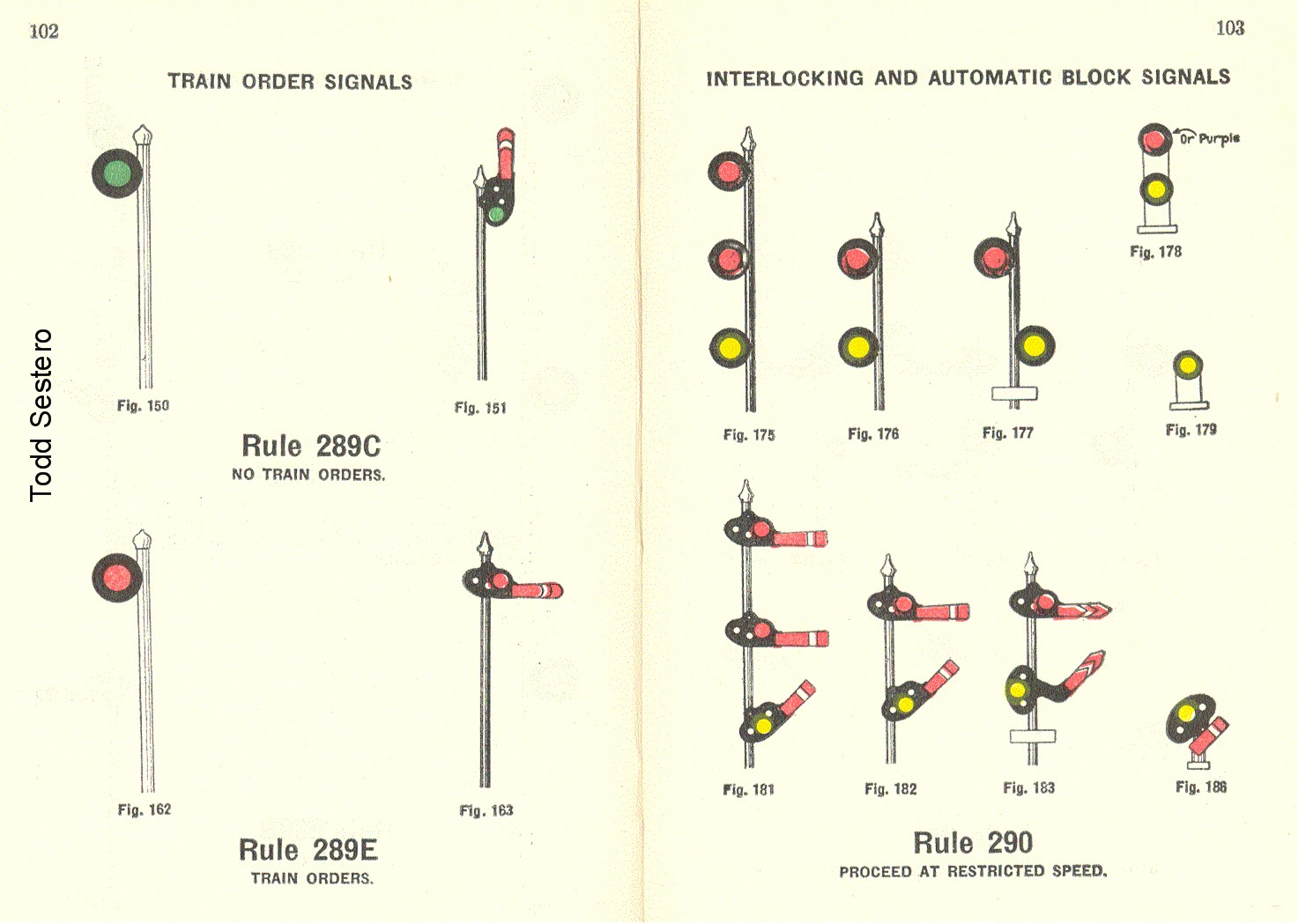
Rule 290 - In the upper position of the 2 aspect dwarf color light signal.
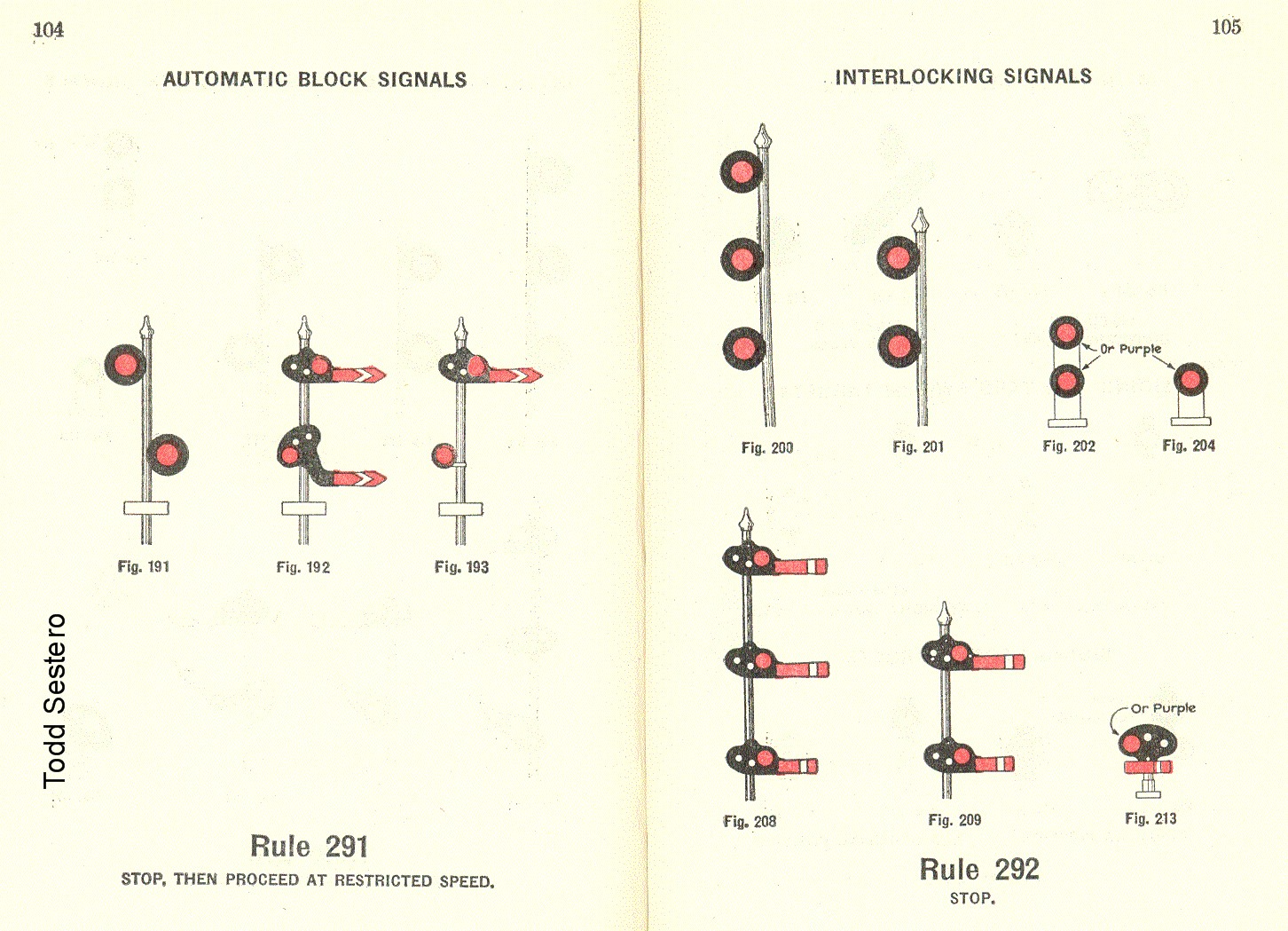
Rule 292 - Stop in all three dwarf signals: semaphore and 1 and 2 aspect color light.
Rule 293 - Siding derail target, in derail position.
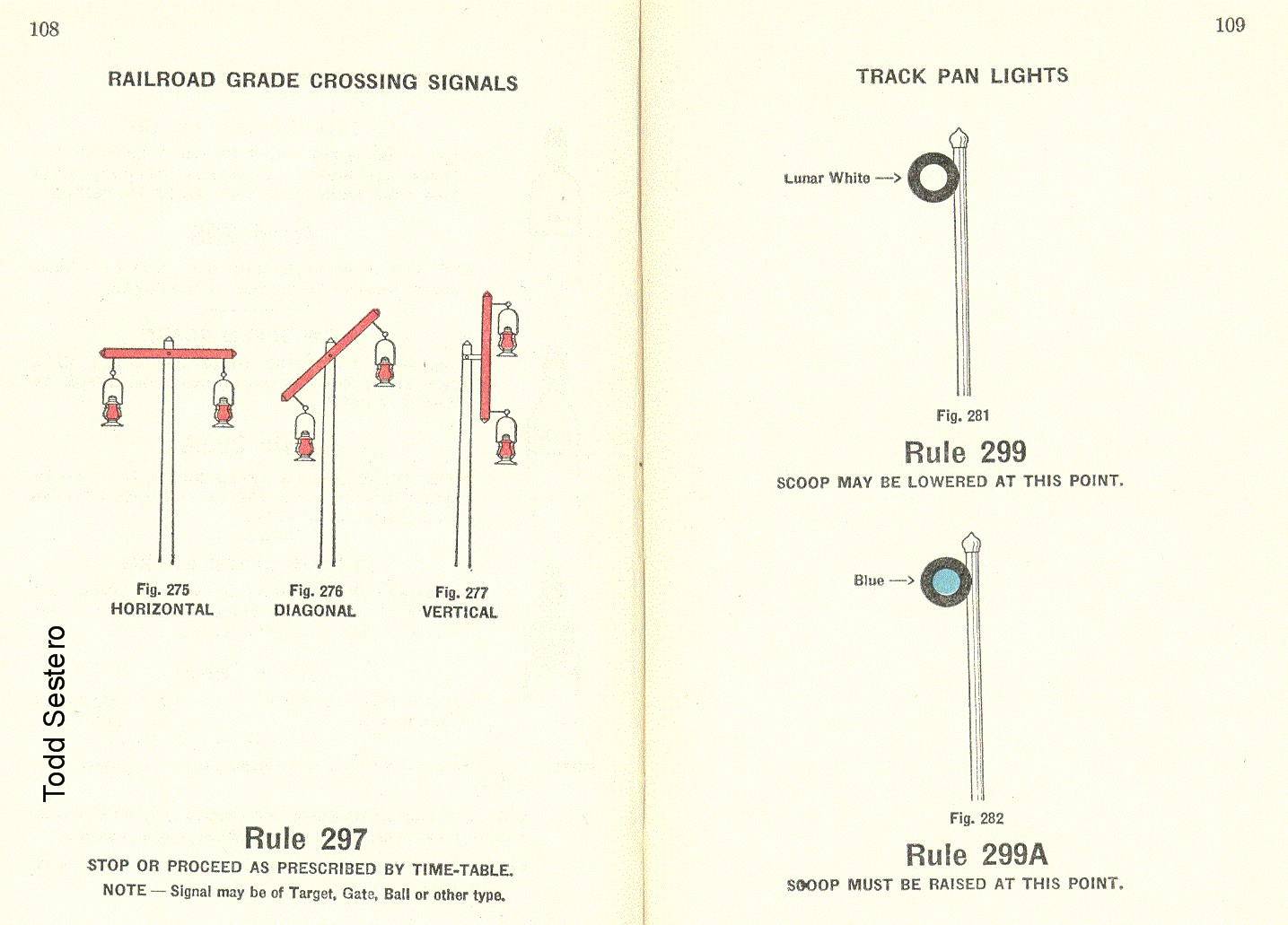
Note the use of BLUE in Rule 299A for raising the water scoops.
Sorry, couldn't fit everything on the single page reference.
Their is also no use or reference to doll posts / arms.
Click here for my quick reference sheet in PDF format.
The rulebook scans are below my quick reference sheets.
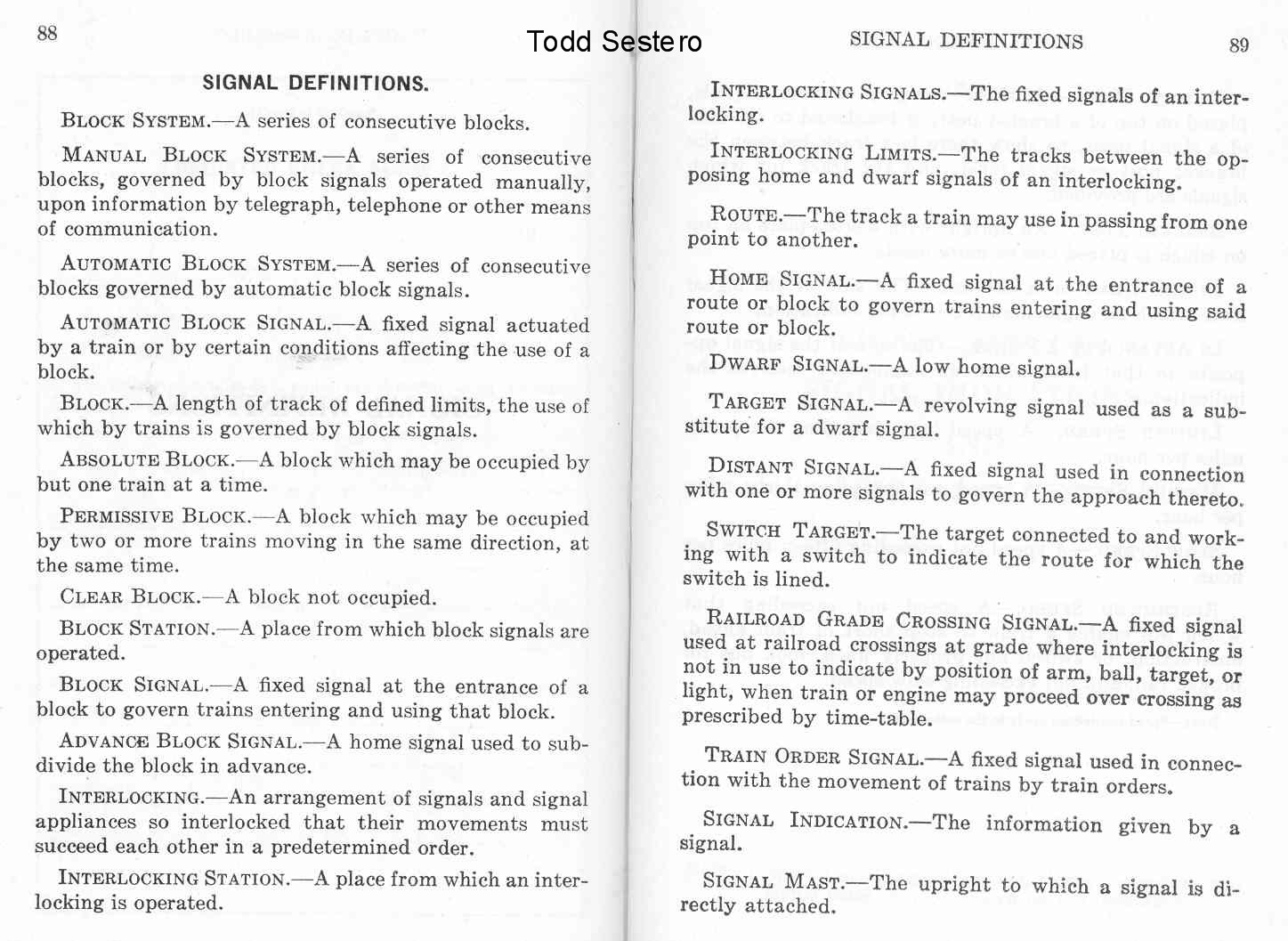
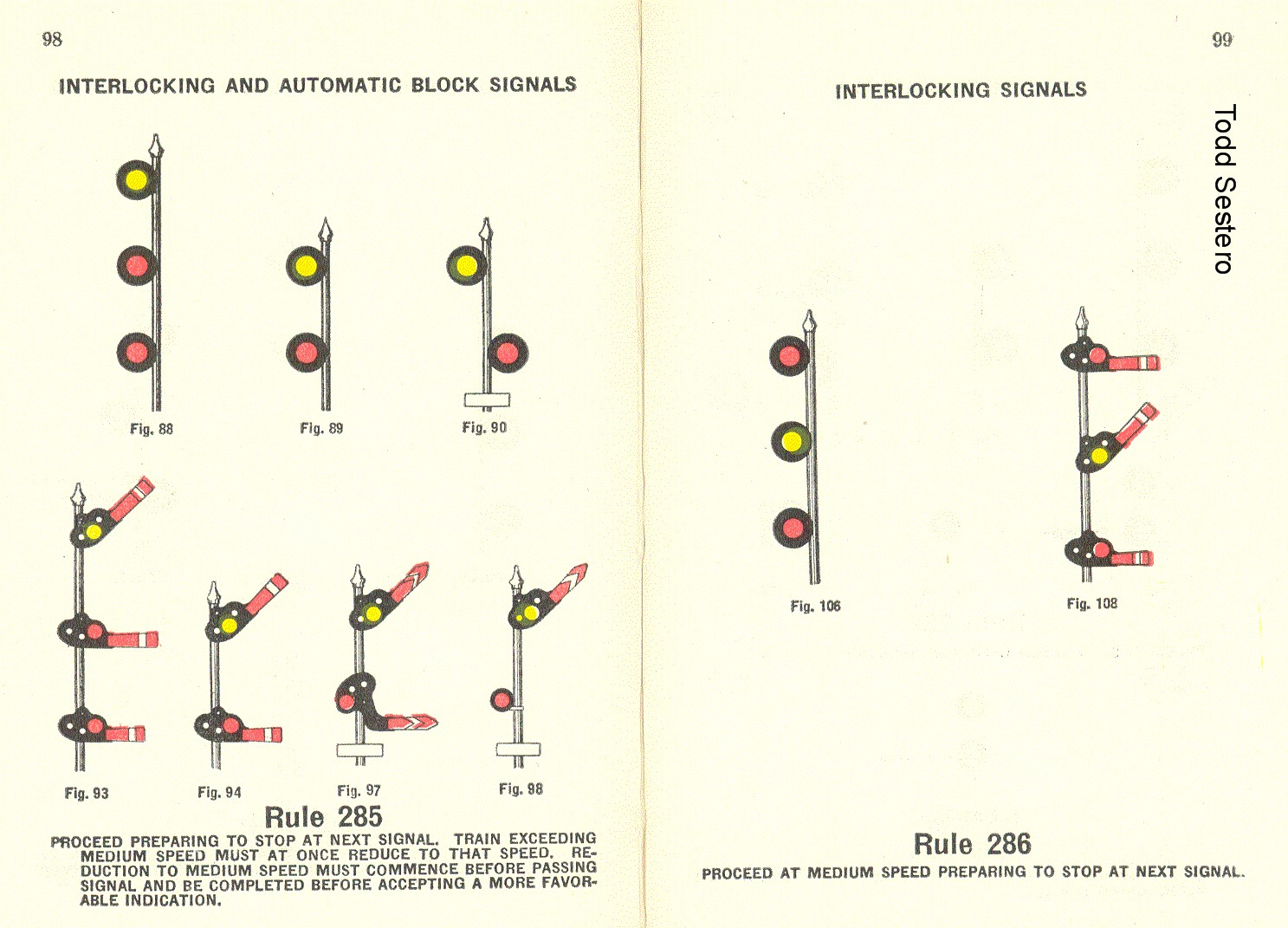
P.88/P.89 Signal Definitions
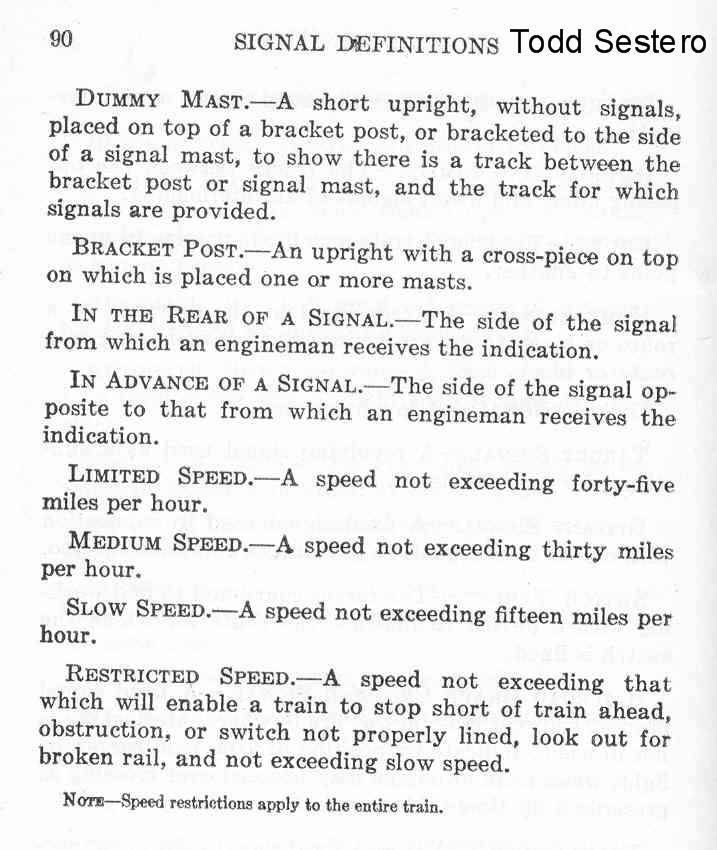
P.90 Signal Definitions
P.91 Cover Page For Signal Aspects, Signal Indications, and Signal Rules
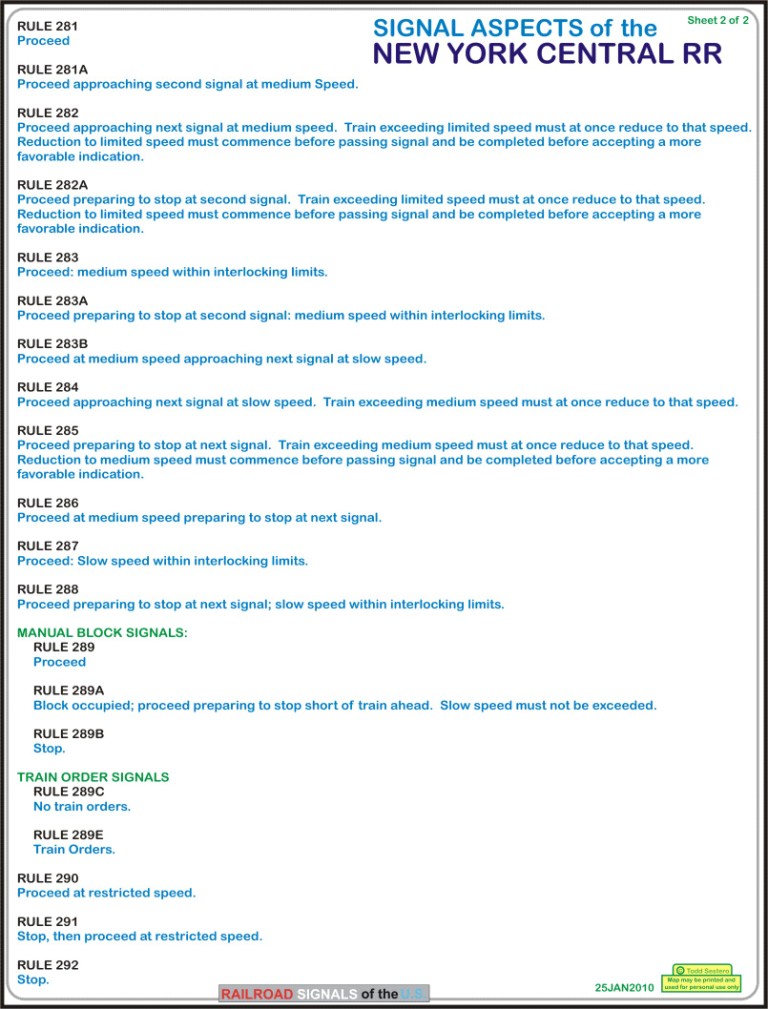
P.92 Rule 281 - Proceed/Searchlights
P.93 Rule 281 - Proceed/Semaphores
P.93 Rule 281A - Proceed approaching second signal at medium speed
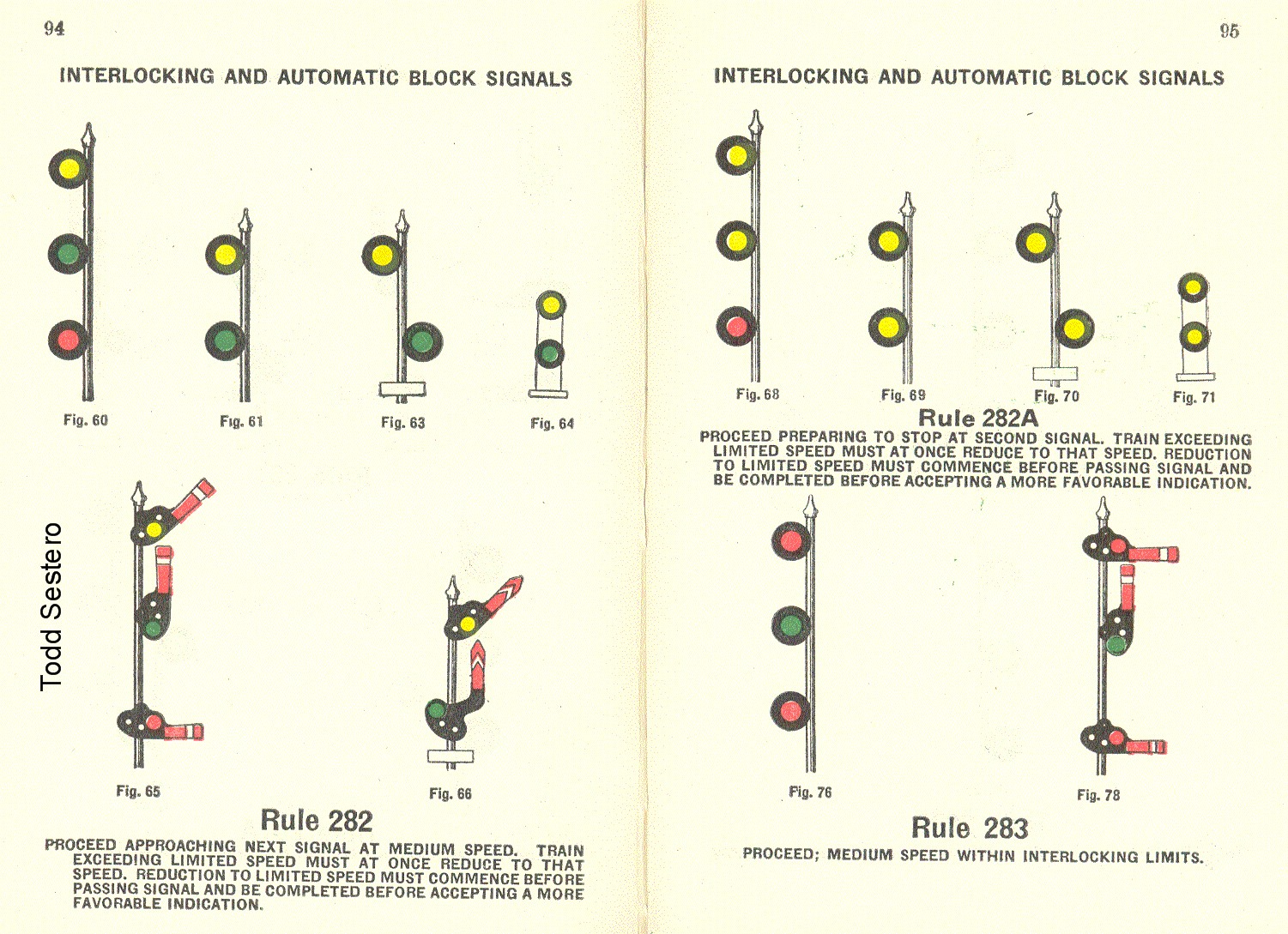
P.94 Rule 282 - Proceed approaching next signal at medium speed. Train exceeding limited speed must at once reduce to that speed. Reduction
to limited speed must commence before passing signal and be completed before accepting a more favorable indication.
P.95 Rule 282A - Proceed preparing to stop at second signal. Train exceeding limited speed must at once reduce to that speed. Reduction to
limited speed must commence before passing signal and be completed before accepting a more favorable indication.
P.95 Rule 283 - Proceed: medium speed within interlocking limits.
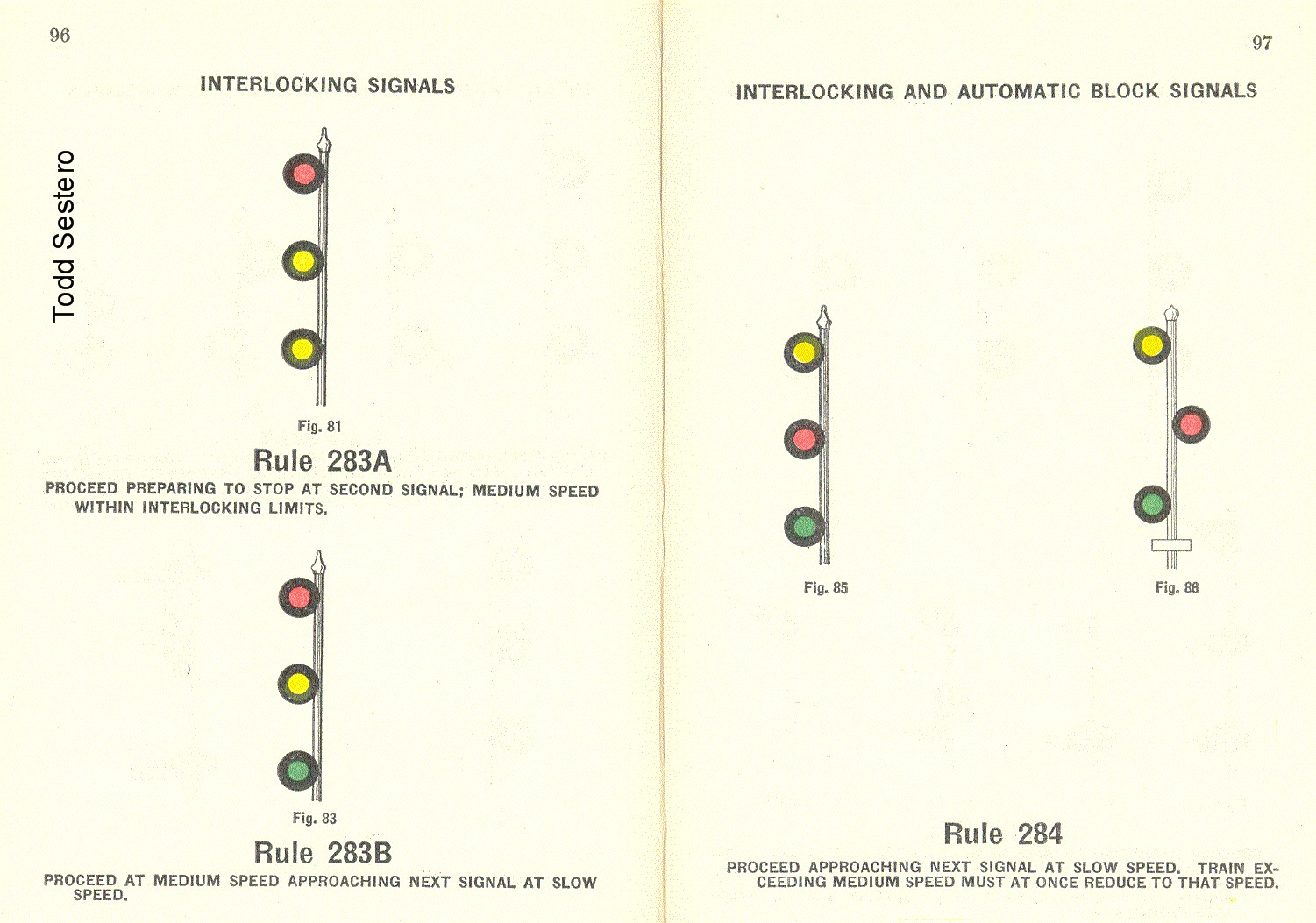
P.96 Rule 283A - Proceed preparing to stop at second signal: medium speed within interlocking limits.
P.96 Rule 283B - Proceed at medium speed approaching next signal at slow speed.
P.97 Rule 284 - Proceed approaching next signal at slow speed. Train exceeding medium speed must at once reduce to that speed.
P.98 Rule 285 - Proceed preparing to stop at next signal. Train exceeding medium speed must at once reduce to that speed. Reduction to
medium speed must commence before passing signal and be completed before accepting a more favorable indication.
P.99 Rule 286 - Proceed at medium speed preparing to stop at next signal.
P.100 Rule 287 - Proceed: Slow speed within interlocking limits.
P.100 Rule 288 - Proceed preparing to stop at next signal; slow speed within interlocking limits.
P.101 Manual block signals:
-- Rule 289 - Proceed
-- Rule 289A - Block occupied; proceed preparing to stop short of train ahead. Slow speed must not be exceeded.
-- Rule 289B - Stop
P.102 Train order signals
-- Rule 289C - No train orders
-- Rule 289E - Train orders
P.103 Rule 290 - Proceed at restricted speed.
P.104 Rule 291 - Stop, then proceed at restricted speed.
P.105 Rule 292 - Stop