RAILROAD SIGNALS of the U.S.
The
Baltimore Light Rail System
How the Light Rail Vehicles Work
CHAPTER 1
INTRODUCTION
CHAP 1 -
Introduction
CHAP 2 - Some Basic Specs
CHAP 3 - Locations of Major Equipment
CHAP 4 - the "TRACS" Computer System
CHAP 5 - High Voltage, Auxiliary and Propulsion Systems
CHAP 6 - Low Voltage Systems and Batteries
CHAP 7 - the Air System
CHAP 8 - the Braking System
CHAP 9 - the Suspension System
CHAP 10 - Trucks
CHAP 11 - the HVAC Units
CHAP 12 - the PA and Intercom System
CHAP 13 - the Pantographs
CHAP 14 - the Doors
CHAP 15 - the Couplers
CHAP 16 - the Lighting System
CHAP 17 - the Destination Signs
CHAP 18 - Winterization
CHAP 19 - Operation
CHAP 20 - Maintenance
CHAP 21 - Floobydust
1.1 Almost every time I visit the Baltimore Streetcar Museum, I invariably hear someone talking about or comparing the old streetcars to the new LRV's. Some of the facts I hear repeated are true, others are not. Statements such as: "the reason they only do 10mph through the "Rebel Yell" is because if the pans bounce off the wire far enough, they will latch into the down position". This was one of those "urban legend" type statements, as the pans don't latch down, they can only be held down by the motor. The need for a speed restriction going through there is for several reasons, 1) the track alignment, 2) the grade, and 3) the 6" clearance going under Howard St. Anyway, since I used to be around these things on a daily basis, I thought I would share some of what I know with you.
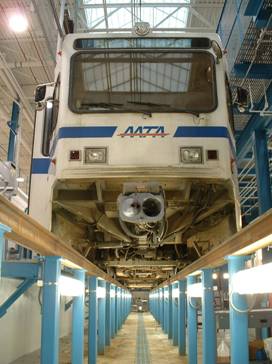
Picture 1-1 An LRV
over a service pit at Cromwell
1.2 Oh yea, disclaimer time.....since this document is not an official MTA document, the opinions expressed are my own and should not necessarily bear any resemblance to official MTA policies or statements, and, of course, I could be wrong (probably not by much though).
1.3 Here is a run down on some of the
basic terminology used in conjunction with the LRVs:
-- AUXED
ON/AUXED UP: The LRV is up
and running (computer and auxiliaries operating) and ready to
move.
-- AUXED OFF: The LRV has been shut down, and only the crew switches and layover
circuits are operational.
-- KEYED UP: The operator has activated the cab and cab functions (switched the
"ignition" "on" using the "81" key)
-- KEYED DOWN: The operator has deactivated the cab.
-- LAYOVER MODE: This is the lowest level of storage normally used, marker lamps
and cab lights go out, and the only way to get the LRV into a more complete
shutdown is to throw the main battery breaker.
-- DC LINK VOLTAGE: This is the 750 volts coming from the catenary.
New 10/6/2006....
Last
Modified Sunday, 29 January 2012